New web practice · teacher review pending. This original HODRA activity is a short introduction and check, rather than the complete teaching lesson.
01
Bacteria are prokaryotic cells
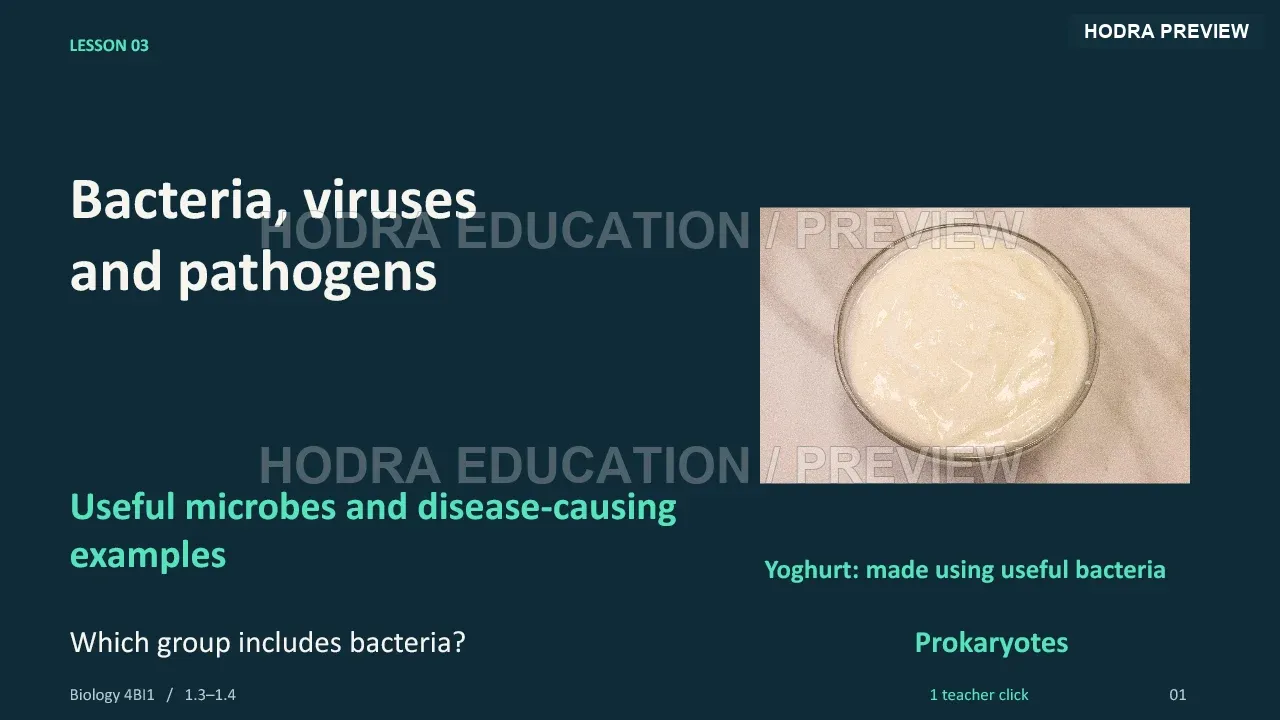
Bacteria are microscopic and single-celled. They have a cell wall, cell membrane and cytoplasm. Their circular chromosome of DNA is not enclosed in a nucleus; plasmids are small additional rings of DNA. Some bacteria photosynthesise, but most feed on material from other living or dead organisms. Lactobacillus bulgaricus is rod-shaped and used to make yoghurt. Pneumococcus is spherical and can cause pneumonia.
02
A pathogen causes disease
A pathogen is a disease-causing agent. Pathogens can include fungi, bacteria, protoctists and viruses. This does not mean every member of those groups is pathogenic. For example, the bacterium used in yoghurt production has a useful role, while Plasmodium is a protoctist that causes malaria.
03
Viruses depend on living host cells
Viruses are smaller than bacteria, have no cellular structure and are not classed as living organisms in this specification. A virus has a protein coat and genetic material that is either DNA or RNA. It can reproduce only inside living cells. Tobacco mosaic virus causes leaf discolouration by preventing chloroplast formation; influenza virus causes flu; HIV can cause AIDS.
Try · Explain before revealing
Cell or particle?
Sort the following into bacteria, viruses, or both: circular chromosome not inside a nucleus; no cellular structure; can include pathogens; reproduction depends on a living host cell; cell membrane and cytoplasm.
Check the explanation
Bacteria: circular chromosome not inside a nucleus; cell membrane and cytoplasm. Viruses: no cellular structure; reproduction depends on a living host cell. Both groups can include pathogens.
Correct a misleading headline
Rewrite ‘All microbes are dangerous and all viruses are tiny cells’ as two accurate statements.
Compare with a model response
Some microorganisms are pathogenic, while others are useful or do not cause disease. Viruses are small particles without cellular structure, rather than cells, and reproduce only within living host cells.
Check · Four original questions
What can you explain?
Choose an answer for each question, then check all four. Answers stay on this page and are cleared on reload.
Model answers and reteach support
Write or say your explanation before opening the answer.
1. Where is the main bacterial chromosome found?
In the cytoplasm, not enclosed in a nucleus. Bacteria have circular chromosomal DNA without a surrounding nucleus. They are prokaryotic.
2. Which statement describes a virus?
It reproduces only inside living cells. Viruses depend on living cells for reproduction. Their genetic material is one type of nucleic acid, either DNA or RNA, inside a protein coat.
3. Which statement uses ‘pathogen’ correctly?
Fungi, bacteria, protoctists and viruses can include pathogens. A pathogen causes disease. Pathogens can occur in each of these groups, but not all members cause disease.
4. Which pair is correctly matched?
Tobacco mosaic virus — discoloured tobacco leaves. Tobacco mosaic virus can discolour leaves. Lactobacillus bulgaricus is used to make yoghurt, while Pneumococcus can cause pneumonia.
Teach · Editable lesson pack
Take it into class.
Explore the existing presentation and exact pack inventory. The full teaching files are delivered separately through the shop.
40editable slides
9supporting PDFs
12files in the ZIP
1.3–1.4specification references
Explore before choosing
Ten selected slides include the available reveals and moving visuals. Remaining slides are blurred in the public preview. See the shop for current price, availability and exact contents.
Editable presentations are designed for desktop PowerPoint. Buying terms cover one teacher and their classes, with separate open-licence rights retained.
Curriculum checked against Pearson Edexcel International GCSE Biology (4BI1), Issue 3, September 2024, printed pages 11–12, points 1.3–1.4. These new questions are original HODRA practice, not official Pearson examination questions.