New web practice · teacher review pending. This original HODRA activity is a short introduction and check, rather than the complete teaching lesson.
01
Retrieve before looking
Name the eight shared characteristics of living organisms: nutrition, respiration, excretion, response to surroundings, movement, control of internal conditions, reproduction, and growth and development. Explain a real example for each, rather than only memorising the words.
02
Compare the evidence
A nucleus identifies a eukaryotic cell. Plant cells have cellulose walls; fungal cells have chitin walls; animal cells have no cell walls. Protoctists include Amoeba, Chlorella and Plasmodium. Bacteria lack a nucleus and have circular chromosomal DNA. Viruses have no cellular structure and depend on living host cells for reproduction.
03
Make a complete explanation
Use ‘because’ to connect a feature with your classification. For example, identify yeast as a fungus using fungal features, rather than assuming every single-celled organism is a bacterium. A pathogen causes disease, and can be a fungus, bacterium, protoctist or virus.
Try · Explain before revealing
Build a comparison from memory
Draw columns for plants, animals, fungi, protoctists, bacteria and viruses. Add whether they have a nucleus, one other useful feature and one named example. Check the earlier lessons after you finish.
Check the explanation
Plants: nucleus, cellulose wall, maize. Animals: nucleus, no cell wall, human. Fungi: nucleus, chitin wall, yeast or Mucor. Protoctists: nucleus, varied features, Amoeba or Chlorella or Plasmodium. Bacteria: no nucleus, circular chromosomal DNA, Lactobacillus bulgaricus or Pneumococcus. Viruses: no nucleus or cellular structure, host-dependent reproduction, TMV or influenza virus or HIV.
Spot and repair three errors
‘Chlorella is a plant because it has chloroplasts. Yeast is a bacterium because it is single-celled. All bacteria cause disease.’ Correct each statement and justify the correction.
Compare with a model response
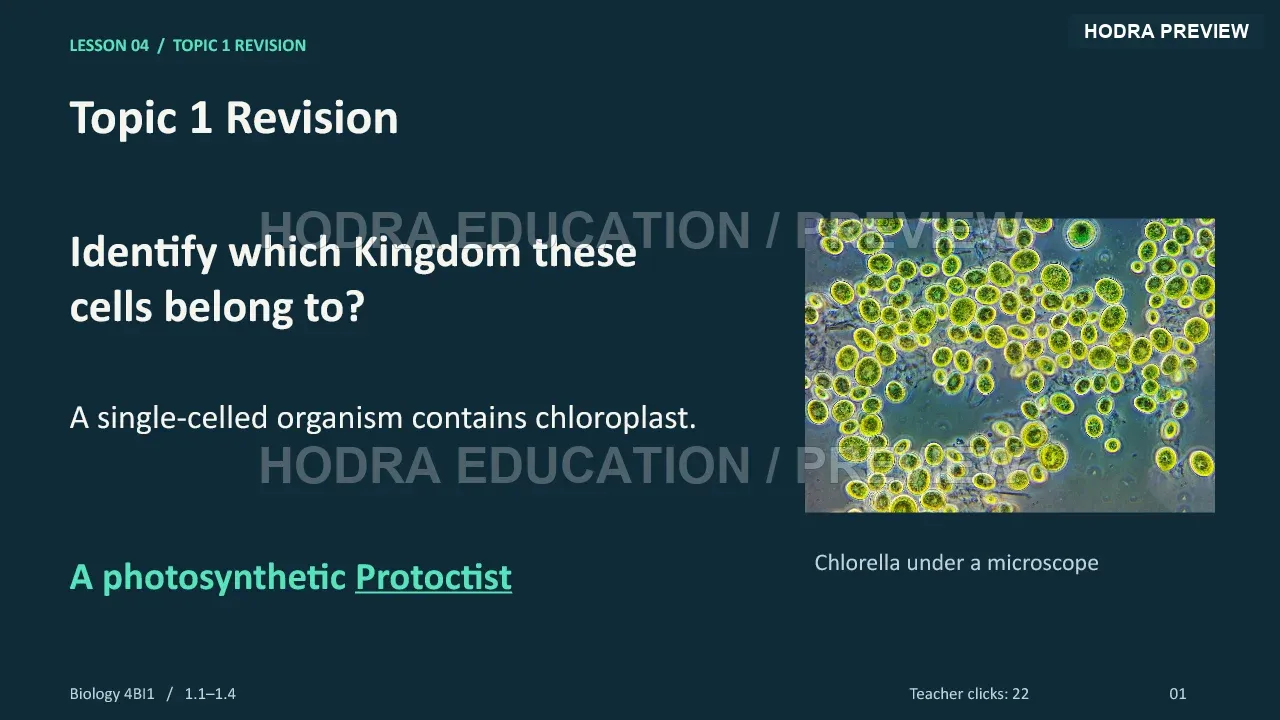
Chlorella is a photosynthetic protoctist, so chloroplasts alone do not identify a plant. Yeast is a single-celled fungus, so being single-celled does not identify a bacterium. Only some bacteria are pathogenic; Lactobacillus bulgaricus is useful in yoghurt production.
Check · Four original questions
What can you explain?
Choose an answer for each question, then check all four. Answers stay on this page and are cleared on reload.
Model answers and reteach support
Write or say your explanation before opening the answer.
1. A single-celled organism has a nucleus and chloroplasts and matches the Chlorella example. Which group fits?
Protoctists. Chlorella is a photosynthetic protoctist. A nucleus rules out a prokaryotic bacterium.
2. Which feature distinguishes a bacterium from a virus?
A bacterium has cytoplasm and a cell membrane. Bacteria are cells with cytoplasm and a cell membrane. Viruses have no cellular structure. Both can include pathogens.
3. Which statement correctly compares fungi with plants?
Fungi have chitin walls; plants have cellulose walls. Fungal walls contain chitin and plant walls contain cellulose. Fungi do not photosynthesise.
4. Which explanation correctly identifies a response to surroundings?
A plant shoot bends towards light as it grows. Directional growth towards light demonstrates a response to surroundings. Growth in height and enzyme secretion illustrate different ideas.
Teach · Editable lesson pack
Take it into class.
Explore the existing presentation and exact pack inventory. The full teaching files are delivered separately through the shop.
40editable slides
10supporting PDFs
12files in the ZIP
1.1–1.4specification references
Explore before choosing
Ten selected slides include the available reveals and moving visuals. Remaining slides are blurred in the public preview. See the shop for current price, availability and exact contents.
Editable presentations are designed for desktop PowerPoint. Buying terms cover one teacher and their classes, with separate open-licence rights retained.
Curriculum checked against Pearson Edexcel International GCSE Biology (4BI1), Issue 3, September 2024, printed pages 11–12, points 1.1–1.4. These new questions are original HODRA practice, not official Pearson examination questions.