New web practice · teacher review pending. This original HODRA activity is a short introduction and check, rather than the complete teaching lesson.
01
Plants and animals
Plants are multicellular. Photosynthetic plant cells contain chloroplasts; plant cells have cellulose walls. Plants store carbohydrate as starch or sucrose. Examples include maize and peas or beans. Animals are multicellular, with no cell walls or chloroplasts. They usually have nervous coordination and can move from place to place, and often store carbohydrate as glycogen. Humans, houseflies and mosquitoes are examples.
02
Fungi use a different route to nutrition
Fungi do not photosynthesise. They secrete digestive enzymes onto food, then absorb the soluble organic products. This is saprotrophic nutrition. Their cell walls contain chitin, and they may store glycogen. Mucor forms a mycelium of thread-like hyphae containing many nuclei. Yeast is a single-celled fungus.
03
Protoctists show variety
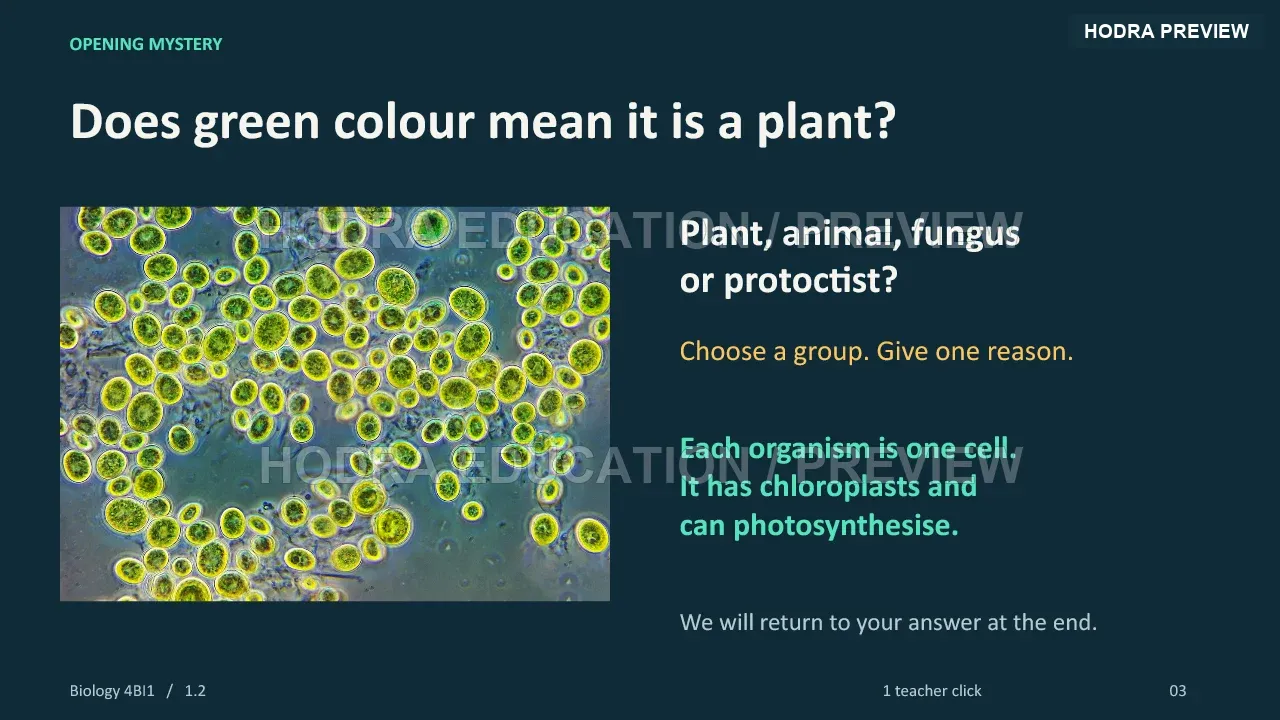
The specification describes protoctists as microscopic single-celled organisms. Amoeba has animal-like features. Chlorella has chloroplasts and photosynthesises. Plasmodium is a pathogenic protoctist that causes malaria. Eukaryotic cells have their genetic material enclosed in a nucleus.
Try · Explain before revealing
Sort by evidence
Match these descriptions to a group: A has cellulose cell walls and stores starch. B has chitin cell walls and secretes digestive enzymes. C is a single cell with a nucleus and chloroplasts, like Chlorella. D is multicellular, with no cell walls or chloroplasts.
Check the explanation
A plant; B fungus; C protoctist; D animal. Use several features together. A chloroplast alone does not distinguish plants from photosynthetic protoctists.
Explain the exception
A pupil puts yeast in the protoctist group because it is single-celled. Explain why that evidence is insufficient.
Compare with a model response
Yeast is a single-celled fungus. Being single-celled does not by itself identify a protoctist. Fungal features include chitin cell walls and nutrition by enzyme secretion followed by absorption.
Check · Four original questions
What can you explain?
Choose an answer for each question, then check all four. Answers stay on this page and are cleared on reload.
Model answers and reteach support
Write or say your explanation before opening the answer.
1. Which combination best supports classifying an organism as a fungus?
Chitin walls and secretion of digestive enzymes. Fungal walls contain chitin. Saprotrophic fungi secrete enzymes onto food and absorb the organic products.
2. Which organism is a single-celled fungus?
Yeast. Yeast is the single-celled fungal example in specification 1.2. Chlorella and Amoeba are protoctist examples.
3. Which statement about Chlorella is correct for this course?
It is a protoctist with chloroplasts. Chlorella is a single-celled photosynthetic protoctist. It has a nucleus and chloroplasts.
4. Which pair correctly matches a group to its cell wall material?
Plants — cellulose; fungi — chitin. Plant cell walls contain cellulose and fungal cell walls contain chitin. Animal cells have no cell walls.
Teach · Editable lesson pack
Take it into class.
Explore the existing presentation and exact pack inventory. The full teaching files are delivered separately through the shop.
40editable slides
9supporting PDFs
12files in the ZIP
1.2specification references
Explore before choosing
Ten selected slides include the available reveals and moving visuals. Remaining slides are blurred in the public preview. See the shop for current price, availability and exact contents.
Editable presentations are designed for desktop PowerPoint. Buying terms cover one teacher and their classes, with separate open-licence rights retained.
Curriculum checked against Pearson Edexcel International GCSE Biology (4BI1), Issue 3, September 2024, printed pages 11–12, points 1.2. These new questions are original HODRA practice, not official Pearson examination questions.