 Education
01 / Slides
Make the process visible.
Labelled diagrams, questions and teacher-controlled reveals. Ten selected slides are visible; the remaining slides are blurred in the public preview.
Try the animated slides ↗Watch the narrated pack tourBiology · Lesson 24 · Pearson Edexcel 4BI1
From the first question to the final check. Explore the teaching materials, learn how gases move and choose what to practise next.
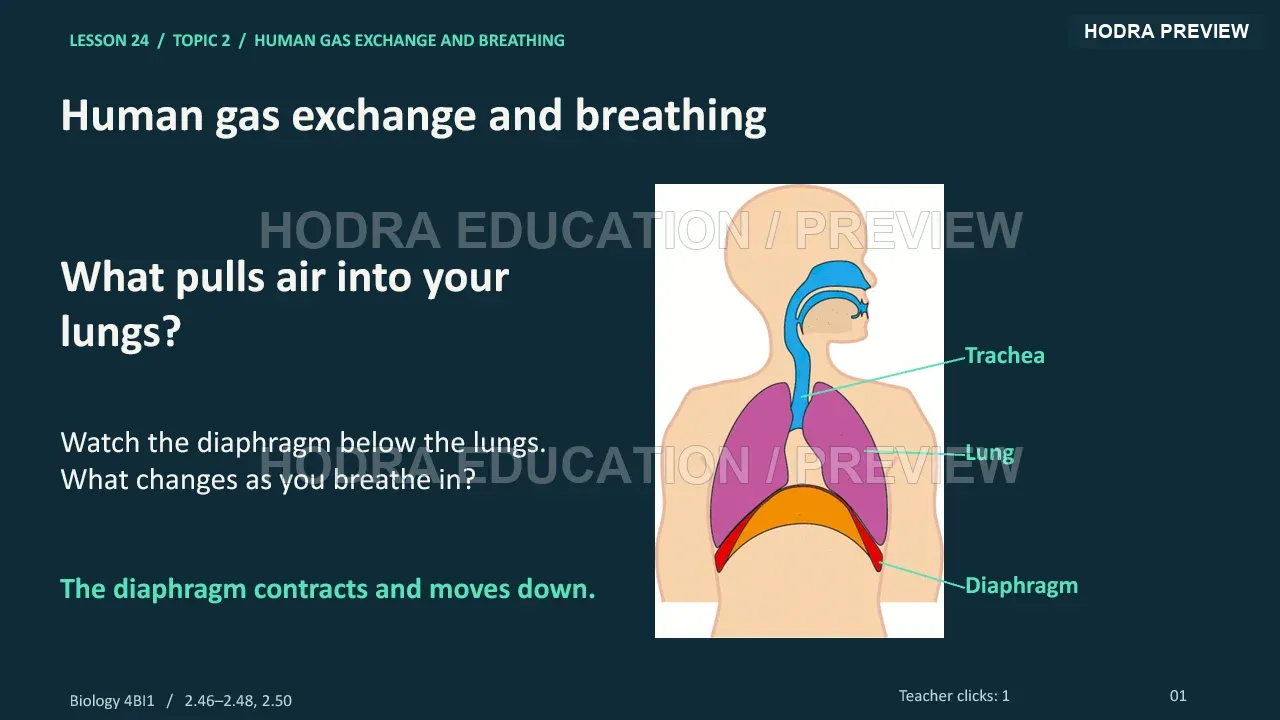 ▶ Try the animated slide preview
Teach · A complete lesson pack
Preview the actual materials before choosing the pack. These samples are permanently watermarked.
01 / Slides
Labelled diagrams, questions and teacher-controlled reveals. Ten selected slides are visible; the remaining slides are blurred in the public preview.
Try the animated slides ↗Watch the narrated pack tour02 / Teacher guide
A three-page guide accompanies the teaching slides.
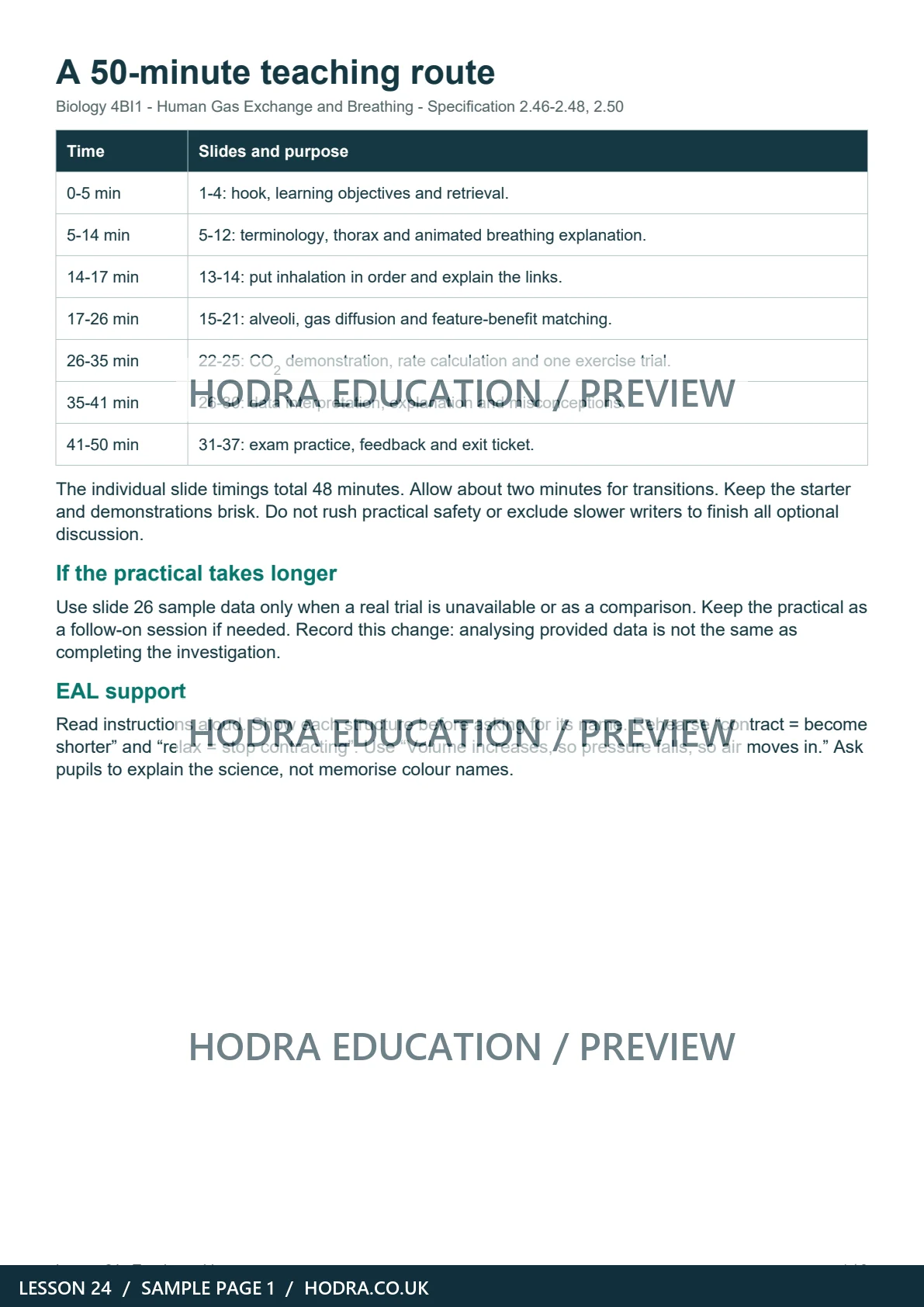
Page 1 of 3 · Watermarked excerpt
03 / Pupil work
The four-page pupil booklet supports practice alongside the lesson.
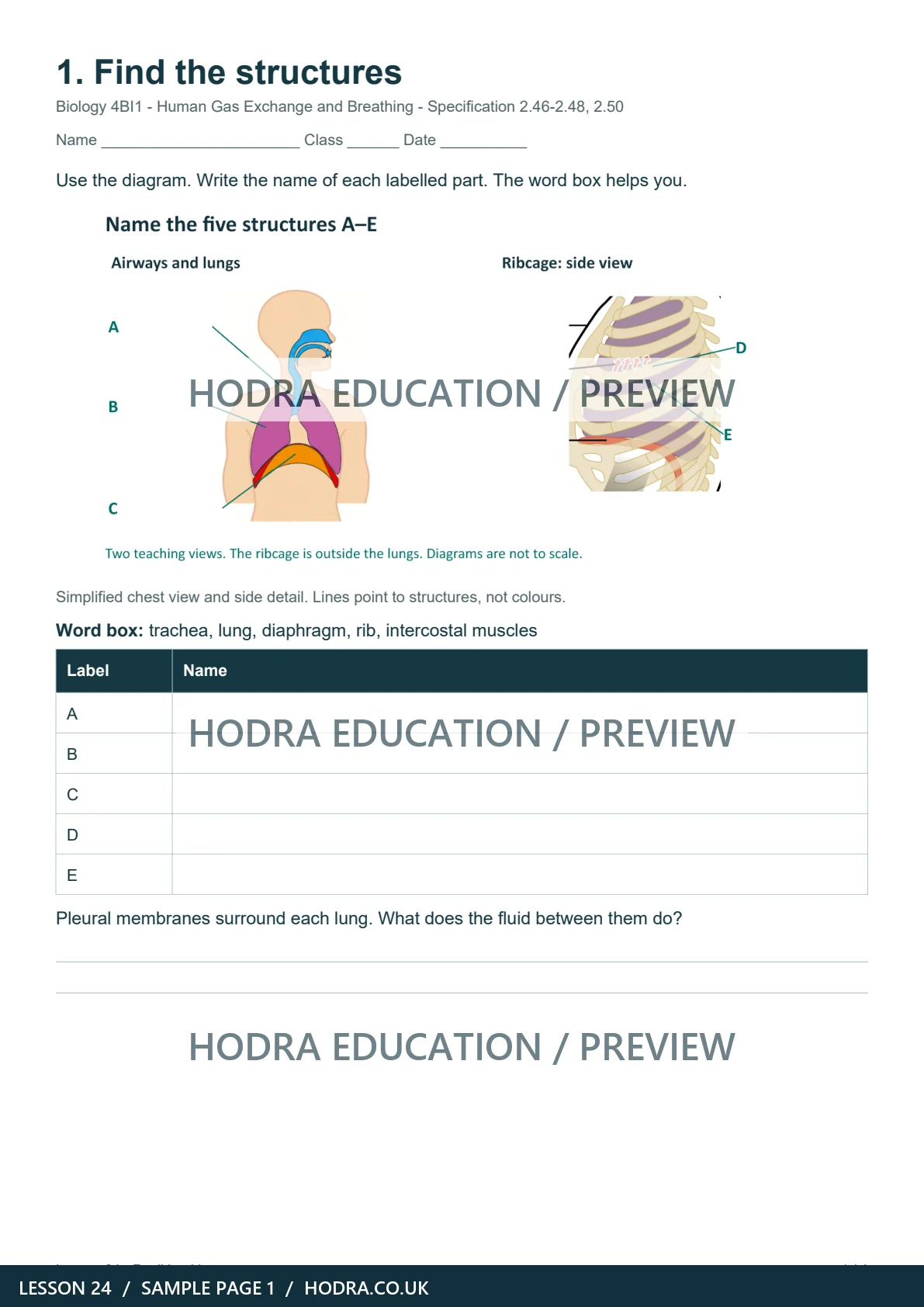
Page 1 of 4 · Watermarked excerpt
04 / Answers
The two-page booklet answer sheet supports feedback and correction.
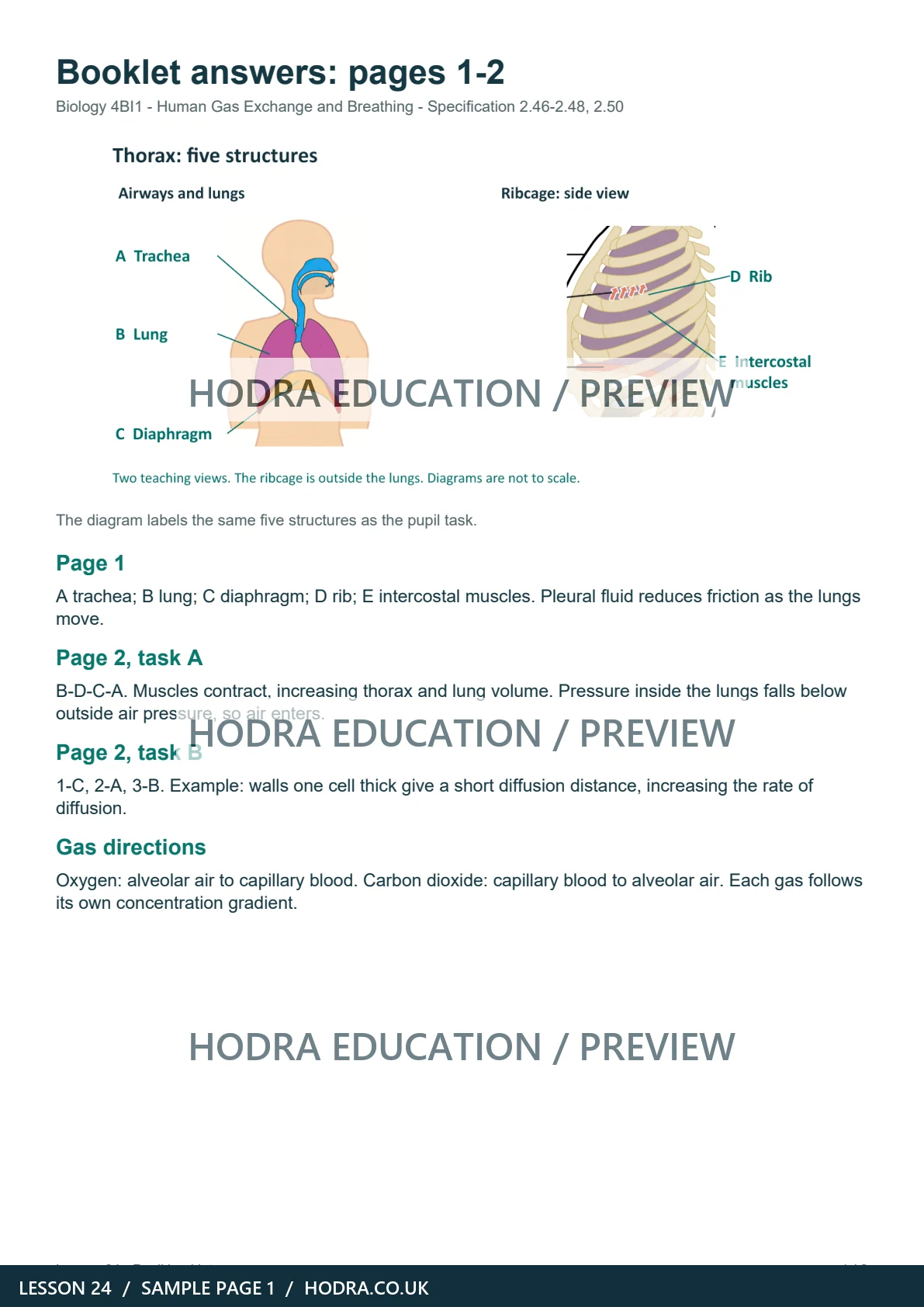
Page 1 of 2 · Watermarked excerpt
05 / Homework
A two-page homework resource helps pupils revisit the content.
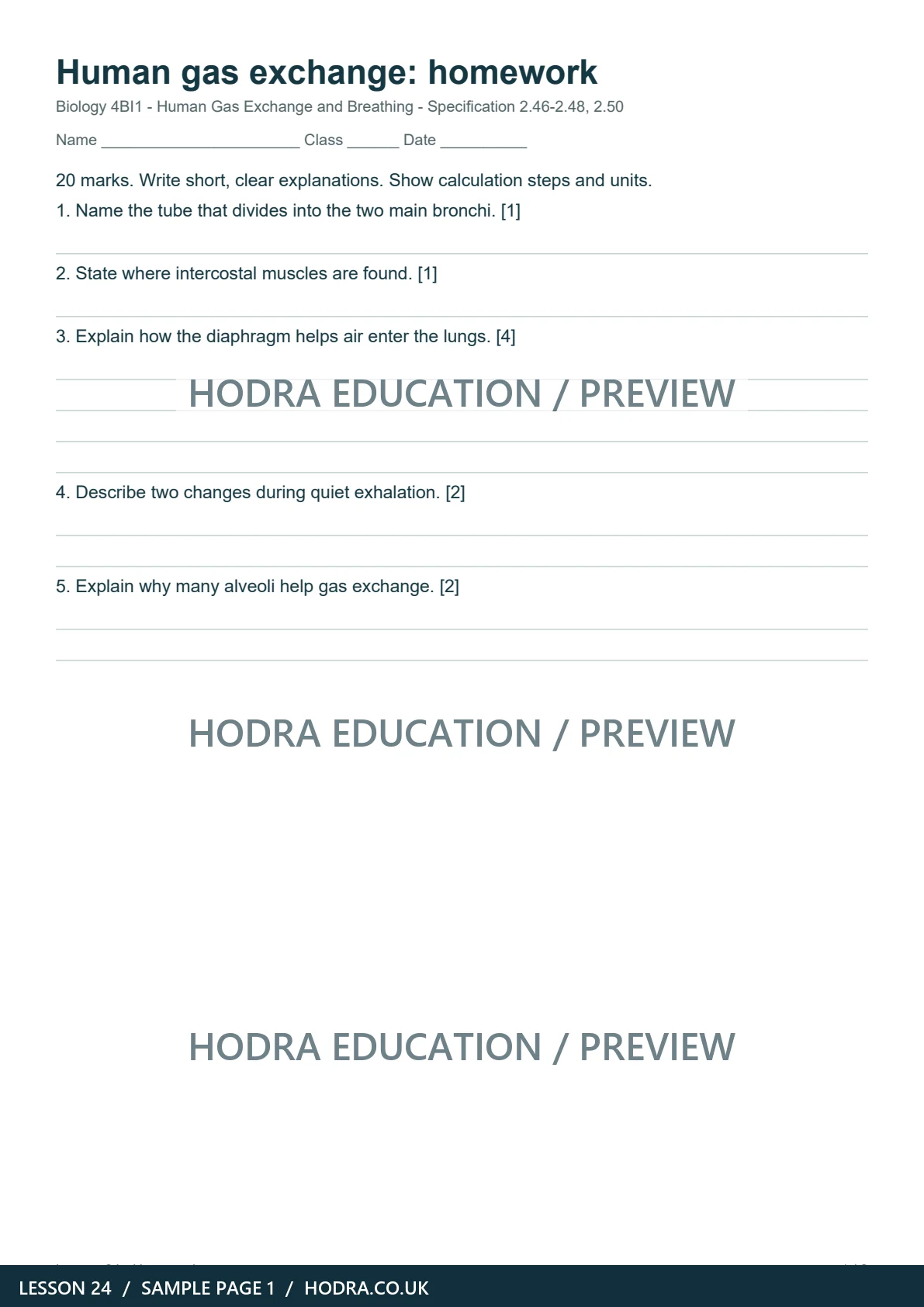
Page 1 of 2 · Watermarked excerpt
06 / Revision
A three-page revision guide supports later review.
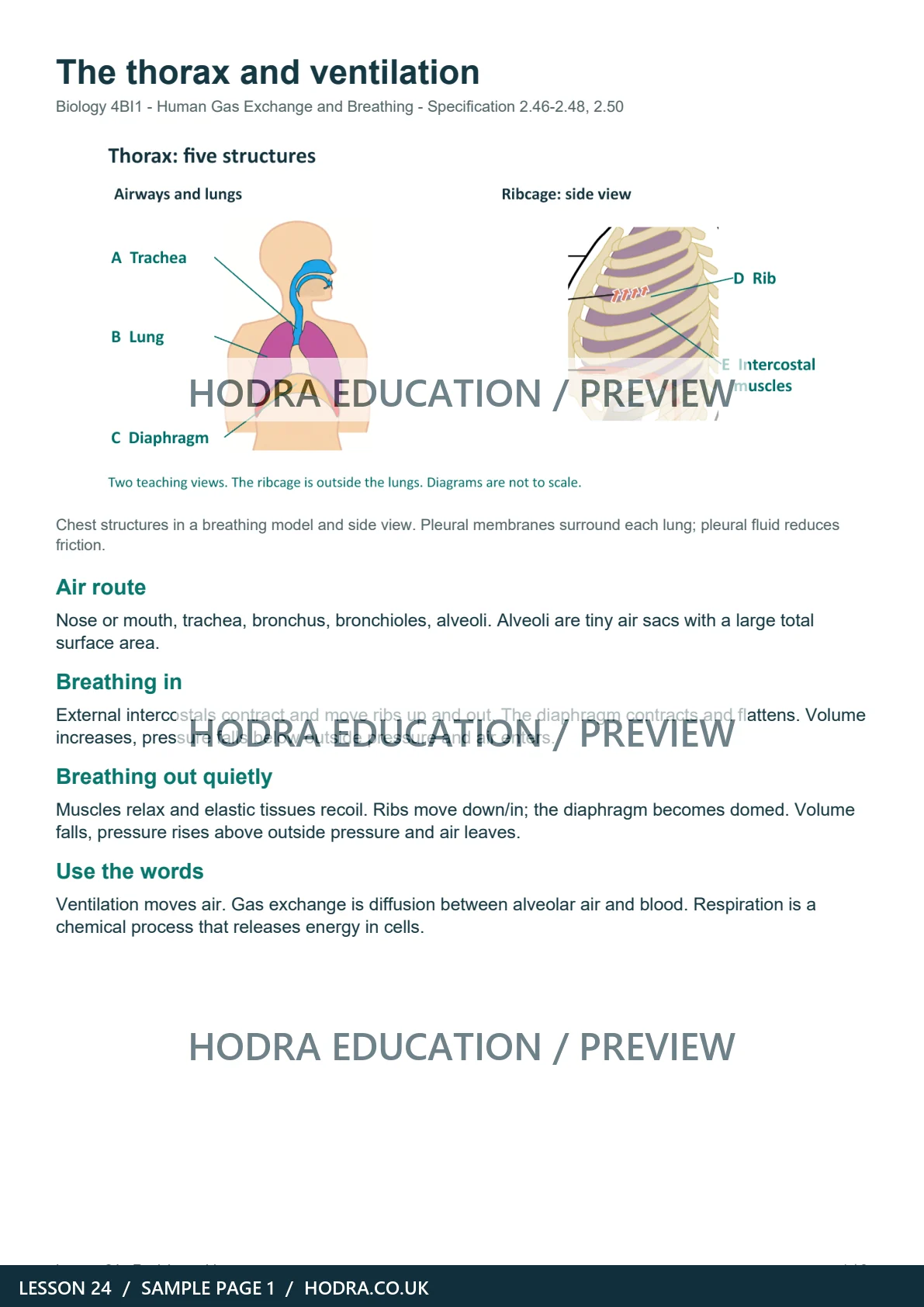
Page 1 of 3 · Watermarked excerpt
Learn · Free pupil activity · About 5–10 minutes
Read the explanation, trace each gas, then test your understanding. No sign-in is needed. This short activity practises ventilation and alveolar adaptations in points 2.47–2.48.
01 / Learn the idea
By the end, you should be able to explain how air enters the lungs and how the alveoli help oxygen and carbon dioxide diffuse.
Breathing moves air in and out of the lungs. When you breathe in, the diaphragm contracts and flattens. The external intercostal muscles contract, lifting the ribs up and out. The volume of the thorax increases and pressure in the lungs falls below atmospheric pressure, so air flows in.
Gas exchange happens at the alveoli, the tiny air sacs in the lungs. Oxygen and carbon dioxide diffuse in opposite directions, each down its own concentration gradient. Thin alveolar and capillary walls give gases a short diffusion distance. A large total surface area, ventilation and a continuing blood supply help gas exchange.
Keep the terms separate. Respiration is a chemical process in cells that transfers energy. Breathing is ventilation; gas exchange is diffusion across an exchange surface.
Use diaphragm, volume, pressure and air to write or say a sequence. Then explain why a thicker alveolar wall would slow gas exchange.
Choose one answer for each question, then check all four. Your answers stay on this page and are cleared when you reload.
Say or write your answer before opening each question. Then compare your explanation with the model answer.
It contracts and flattens. The volume of the thorax increases, pressure in the lungs falls below atmospheric pressure, and air moves in.
Oxygen diffuses from the air in the alveoli into the blood in surrounding capillaries, down its concentration gradient.
Thin walls give gases a short diffusion distance, so oxygen and carbon dioxide can diffuse across faster.
Gas exchange would be slower, all else being equal. A thicker wall increases the distance that oxygen and carbon dioxide have to diffuse.
The full teaching pack covers Pearson Edexcel International GCSE Biology (4BI1), points 2.46–2.48 and 2.50. This free activity practises selected ventilation and alveolar adaptation ideas in 2.47–2.48. Questions are original HODRA practice questions.
Third-party images and adaptations retain their stated licences. The free gas-diffusion diagram is an original simplified teaching model. Arrows show net diffusion; molecules move randomly in both directions.